



How conditioning became the hidden mechanism behind the human connection crisis
The reality of human disconnection is complex. What follows is a model — one that we believe identifies the essential challenge and the most promising leverage point for overcoming it. We share it in the hope of finding thought partners and collaborators excited to help promote relational connection.
“Imagine two strangers having a conversation, with one caveat: they won’t be able to talk to or see each other again after the conversation ends. What is the value of that conversation?”
Your answer to that question may reveal more than you think.
This is essentially what happens on Acquaint, where we’ve facilitated over 30,000 hours of conversations between strangers across 110+ countries. The platform is intentionally designed to resist instrumentality — using connection to achieve a specific outcome, like trying to build a long-term relationship or close a sale. Participants can’t exchange contact information. The conversations are entirely in the moment.
Many people love it. But some prospective volunteers lose interest when they learn there’s no follow-up. Some of that hesitation is understandable. It’s reasonable to wonder how meaningful a single conversation with a stranger can be. But what’s striking is how often that skepticism dissolves once people try it. The conversations routinely go deeper than participants expect — which suggests the resistance had less to do with the format’s actual limitations than with assumptions about what a conversation with a stranger could be. And yet — some of those same people, once they tried it, ended up swearing by the model.
We’ve spent a lot of time thinking about why. If someone wants to connect with strangers but balks when the conversation can’t produce a specific outcome, the resistance isn’t about the format. It’s about the frame. For many of us, a non-instrumental conversation — one with no specific goal or outcome — doesn’t register as something worth having. Not because we’re uninterested in other people, but because we’ve been trained to evaluate human connection in terms of what it produces. And when it can’t produce anything, it doesn’t feel worth the effort. To be clear: instrumental connection isn’t the enemy. Networking, collaboration, professional relationships — these serve real purposes. The question is what happens when that’s all we practice.
The Mechanism
In the 1970s, psychologists ran a simple experiment. They took children who loved drawing and started giving them rewards for it. When the rewards stopped, the children drew less than kids who were never rewarded at all. The activity hadn’t changed. But the experience of it had. What was play had become labor. Drawing-for-fun and drawing-for-a-reward aren’t the same activity with different incentives. They’re different modes of engagement. One is open-ended, absorbing, intrinsically motivated. The other is evaluative, goal-directed, instrumental. And once the instrumental frame took hold, the children couldn’t easily get back to the other one. Deci and Ryan found this pattern replicated across 128 studies.
Now apply that to human connection.
We were recently discussing Acquaint’s model — hour-long conversations between strangers — with a dean from a prestigious institution. This is someone whose professional life is built on human relationships. His first reaction: “An hour-long conversation with a stranger? That sounds like work.” Not fun. Not interesting. Not relaxing. Work. And he wasn’t wrong about his own experience — that’s what the prospect of connection genuinely feels like to him. But it’s not because he doesn’t like people. It’s because virtually every conversation in his life has a purpose.
One of us (Alex) experienced this shift firsthand. Through school, spending time with friends was never a question. But once college and career started, connecting with people gradually began to feel like work, and worse, like something that would prevent him from getting done all the things he needed to get done — deadlines, taxes, life maintenance. The joy didn’t vanish overnight. It was slowly replaced by a sense that time with people was time away from something more urgent. Practicing relational connection has genuinely restored some of that joy for him, but he’ll be the first to admit that planning and making time for it still feels heavy. The conditioning runs deep.
When the vast majority of our social interactions are instrumental — when we are consistently connecting with people in order to achieve some outcome — the brain does what it always does with repeated associations. It re-categorizes. What was once intrinsically rewarding becomes work. “Person in front of me” stops being an opportunity for joy and starts being a signal: this should either produce something or it’s going to cost me something. And when a conversation can’t produce anything — and human connection is never frictionless — the brain files it as not worth the effort.
But there’s a second form of conditioning that’s just as powerful, and even less visible. When human connection consistently stands between you and something you need to get done — the deadline, the tax filing, the errands, the career milestone — the brain learns a different association. Not that connection is a tool, but that connection is an obstacle. An interruption. Something to push through or postpone so you can get back to what matters. All it takes is a life where what feels urgent consistently wins out over what feels good.
These two forms of conditioning — connection instrumentalized and connection deprioritized — reinforce each other. Together, they shift our default expectation of what being around people feels like. The rewarding parts of connection — the laughter, the sense of being understood, the simple pleasure of someone’s company — haven’t disappeared. But accessing them now requires pushing through a conditioned expectation that this will either be demanding or get in the way. And for many people, that push is enough to make them choose watching shows on the couch.
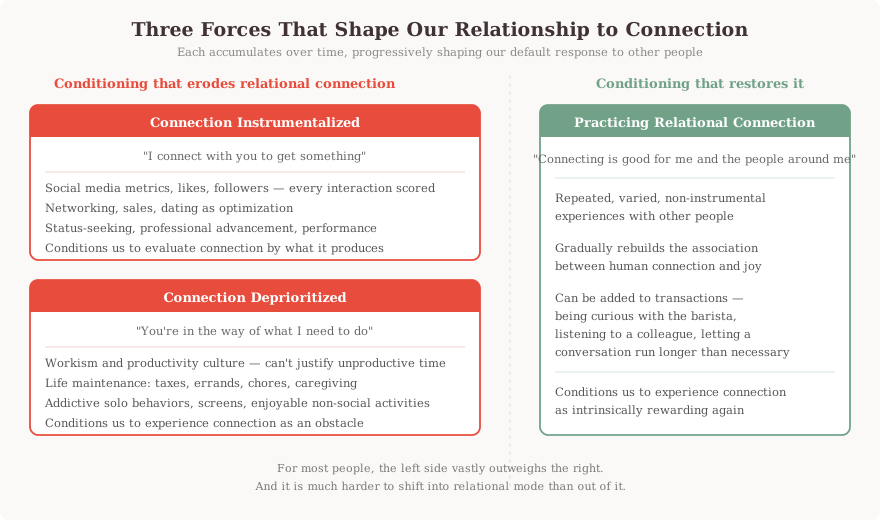
For most people, the left side vastly outweighs the right. And it is much harder to shift into relational mode than out of it.
This, we believe, is the mechanism at the heart of what the former U.S. Surgeon General, Vivek Murthy, has called “our epidemic of loneliness and isolation” — what we’d describe more precisely as a crisis of relational disconnection. Broadly speaking, we don’t lack social interaction. We lack non-instrumental social interaction. And the imbalance has conditioned us to experience connection itself as work. To be sure, many challenges around human connection — prejudice, intergroup distrust, structural inequality — long predate this modern crisis. But the conditioning we describe here may prove to be a barrier to addressing any of them.
How We Got Here
This conditioning didn’t happen overnight, and no single cause explains it. From what we can see, the pattern began accelerating in the post-WWII era, at least in the United States and much of the Western world. What we observe is a set of reinforcing forces — some instrumentalizing connection, some deprioritizing it, all of them deepening the imbalance.
Workism turned productivity into identity. When your worth is measured by output, connection without an agenda becomes the first thing cut — not because people don’t value it, but because they can’t justify it. And the parent who comes home from work with their mind elsewhere, unable to be present with their own family — that’s not a failure of love. It’s the residue of a day where every interaction had a purpose, and the brain hasn’t switched modes yet.
Social media is a double whammy — it instrumentalizes connection and deprioritizes it at the same time. Platforms introduced a model where you post to get likes, follow to be followed back. Every interaction has a metric. Just like those kids who got paid to draw, we’re no longer connecting for the sake of connecting — we’re performing connection for a measurable result. The mode shifts from relational to instrumental, and the intrinsic reward disappears. Meanwhile, the dopamine loops these platforms create offer what seems like social connection but is actually consumption — gamified interaction optimized for engagement rather than for the people using it. And every hour spent scrolling is an hour of real connection deprioritized — outcompeted by something engineered to be easier and more immediately rewarding.
The decline of third places and spontaneous proximity has removed many of the contexts where non-instrumental connection once happened naturally. The cafes, community centers, parks, and gathering spots where people encountered each other without an agenda have been disappearing for decades. And the things that once required leaving the house — shopping, entertainment, even meals — increasingly don’t. You can stream a movie, order dinner, get groceries delivered, and never encounter another person. Meanwhile, the idle moments that once produced spontaneous conversation — waiting in line, sitting on a porch, passing time with nothing to do — are increasingly filled by screens. What remains are scheduled, purpose-driven interactions. Every social encounter requires a reason.
Together, these forces create an environment where connection is simultaneously instrumentalized and deprioritized — turned into a tool when it happens, and crowded out when it doesn’t. And none of this is new. These forces have been compounding for decades — each one deepening the conditioning laid down by the others. We didn’t suddenly develop an epidemic of loneliness. We slowly built one, and only recently crossed the threshold where it became impossible to ignore.
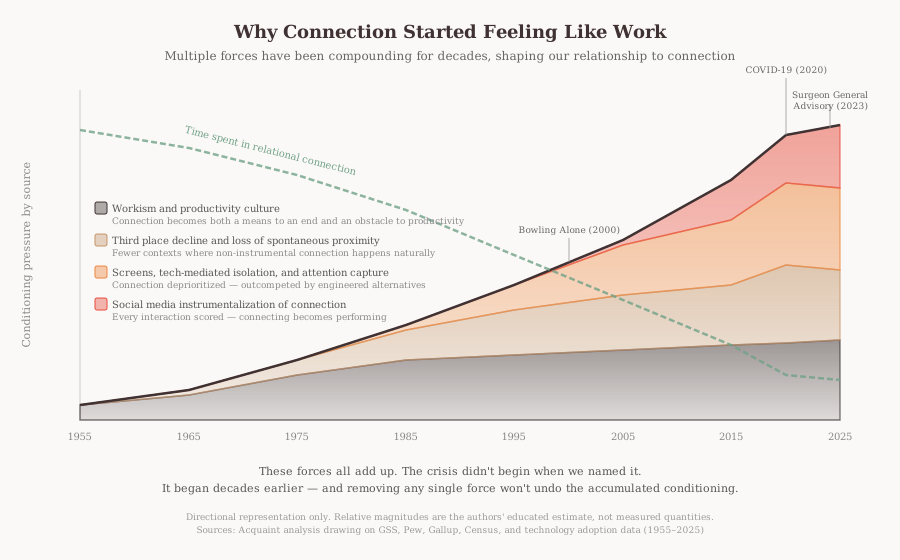
These forces all add up. The crisis didn’t begin when we named it — it began decades earlier.
Two Kinds of Connection
Instrumental connection is one-dimensional. Did we achieve the result or not? There’s a binary quality to it — success or failure, useful or not. There’s no depth. You walk away having completed a task, not having been changed by an encounter.
Relational connection is multidimensional. These aren’t always separate conversations — they can alternate within a single interaction, and most real exchanges contain elements of both. But the modes are distinct, and when the instrumental frame is active, it tends to dominate. The joy could come from anywhere — a moment of unexpected honesty, the discovery of a shared experience, the simple pleasure of being listened to without agenda. Connection doesn’t need a reason to feel good. But when we add a reason — when we instrumentalize it — we shift into a different mode entirely. In instrumental mode, the reward is tied to the outcome: did I get what I came for? The richness of the experience itself — the part that makes connection feel good — isn’t suppressed. It’s just not what we’re paying attention to.
From what we hear from people on Acquaint, relational connection often produces something that resembles a flow state — people describe conversations where no time seemed to pass at all, where the interaction felt effortless, where they forgot to evaluate whether it was “going well” because they were simply in it.
There’s an important asymmetry here. It’s much harder to shift from instrumental mode into an open, relational state than the other way around. Anyone who has tried to relax on the first day of a vacation knows this — the mind keeps returning to the to-do list, the unresolved email, the project you left half-finished. Or think about a conversation where you’re worried about performing well — the harder you try to turn off that evaluation, the louder it gets. You can’t will yourself into a flow state. It takes time to let the instrumental frame dissolve, and anything that re-triggers it — a notification, a goal, an evaluation — snaps you right back.
It makes sense that, for survival, goal-directed behavior would be prioritized over the open, exploratory state that relational connection requires — and it feels like our current world constantly tries to pull us into goals, from tiny dopamine hits to long-term work agendas. This is why the conditioning is so sticky, and why simply creating opportunities for connection isn’t enough.
Have you ever had a conversation like that? One that felt effortless and lasted far longer than you realized? That experience — increasingly rare for many people — is what non-instrumental connection feels like. And its rarity is a measure of how far the conditioning has gone.
The Evidence Hiding in Plain Sight
“Relational human connection is an emergent behavior — it cannot be forced.”
The U.S. Surgeon General’s 2023 advisory reported that roughly half of American adults experience loneliness, with young adults reporting the lowest social connection of any age group. But here’s what’s striking: these same surveys consistently find that people want more social connection. They report wanting closer relationships, more meaningful conversations, more time with others. And yet they don’t see opportunities for it.
Look more carefully, and the opportunities are everywhere. The stranger next to you on the train. The neighbor you’ve never spoken to. The ten minutes between meetings you spend on your phone. What’s missing isn’t opportunity. What’s missing is the perception that these opportunities are worth taking.
There’s another version of this dynamic that’s worth noticing. When researchers ask people why they don’t talk to strangers, one of the most common answers is: “I don’t think the other person would want to talk to me.” This is often understood as a forecasting error — people are bad at predicting how conversations will go, and that’s almost certainly part of it. But conditioning might add another layer. If your default expectation is that social interaction means demand, you’d naturally assume the other person feels the same way. “They won’t want to talk to me” might really mean: “I’ve learned that being around people is work, so they probably think so, too.” It’s not just a prediction error. It may also be projection of a conditioned aversion.
If people consistently say they want connection but can’t see the opportunities that surround them — and actively assume others don’t want it either — the simplest explanation isn’t that the opportunities don’t exist. It’s that we’ve been conditioned not to recognize basic human connection as something desirable — or worse, we’ve come to associate it with work.
Why One Good Conversation Isn’t Enough
Researchers Stav Atir and Nicholas Epley found something they call “fleeting generalization.” Across three experiments, they showed that people who had a positive conversation with a stranger immediately updated their expectations — they became more optimistic about future conversations. But within one to two weeks, that optimism faded almost entirely. They reverted to their baseline pessimism, as if the experience had never happened.
The learning was real. It just didn’t last.
This is consistent with what you’d expect from a conditioning model. A single positive experience is trying to overwrite thousands of data points in the other direction. Of course it’s fleeting. New associations are fragile and context-dependent unless they’re reinforced through varied repetition. One good conversation can’t undo years of training. Neither can two.
The good news is that the underlying capacity for relational joy hasn’t been destroyed — the Atir and Epley findings show it’s right there, accessible in a single conversation. The problem is that without repeated practice, the conditioning reasserts itself.
This also explains something we’ve observed at Acquaint: the people whose relationship to connection actually shifts aren’t the ones who had one great conversation. They’re the ones who kept showing up — across enough variety, and with enough consistency, that the new association started to hold. Many of them tell us they’ve never had conversations like the ones they have on Acquaint — which may itself be a measure of how instrumentalized our social lives have become.
What We Might Be Missing About Solutions
The standard narrative about the connection crisis goes like this: people are disconnected because they lack opportunities to connect. The solution is to create more opportunities.
“If people have been conditioned to experience connection as evaluative, demanding, or costly, then creating more opportunities for connection will predictably underperform.”
And creating opportunities does work — in the moment. The research consistently shows that when people actually have a conversation with a stranger, it goes better than they expected. The challenge has always been making it stick. If the problem is conditioning rather than scarcity, that difficulty makes sense: creating more opportunities without addressing the conditioning just gives people more things to feel exhausted by. Another event on the calendar. Another social obligation. Another context that triggers the same default expectation of demand. Worse, many well-intentioned solutions quietly instrumentalize connection without realizing it — programs that lean too heavily on participation metrics, networking events framed as community, connection initiatives where the measurement becomes the message. The very framing reinforces the conditioning they’re trying to undo. It’s telling that organizations often use “intervention” and “opportunity” interchangeably. Our suggestion: strike “intervention” from the vocabulary entirely. Instead, design opportunities that make space for connection — not more goals. Shared activities and common purposes can be a great excuse to bring people together, but be careful — instrumental conditioning already abounds in those contexts, and adding more structured social interaction without making space for genuine connection may be counterproductive. It’s the unstructured space within those activities that actually matters.
The human connection crisis isn’t primarily a scarcity problem — though time scarcity is real, especially for people juggling multiple jobs or caregiving responsibilities. But even within the interactions we already have, the conditioning shapes whether we experience them as demanding or restorative. And conditioning doesn’t change through awareness or opportunity. It changes through practice — repeated, varied, and deliberately non-instrumental experiences that gradually rebuild the association between human connection and joy.
This isn’t a novel claim. It’s how conditioning has always been undone — exposure therapy, desensitization, cognitive behavioral approaches all work the same way. We’re just pointing out that the same principle applies to how we experience other people. Examining the conditioning element may be key to building on the great work that researchers, practitioners, and advocates have already done — and to making its effects last.
The Leverage Point
Instrumentalization didn’t start the connection crisis single-handedly. But it sits at the heart of every factor we’ve described — and that makes it the leverage point. Because while we can’t easily undo the forces that got us here, we can practice relational connection. That’s how we begin to undo the conditioning.
At Acquaint, this is what we’ve tried to design for: lower the barrier to connection. Focus on the mindset that leads to relationality, not transactionality. Emphasize practice over skills. Presence over productivity. And frame volunteering as permission to make space for relational connection — something that’s good for us, good for the people around us, and good for the world. None of this is complicated. But all of it has to be intentional, because the conditioning pulls in the other direction by default.
This is, admittedly, a hard sell. A practice of conversation without a defined purpose sounds like the least productive thing you could possibly do — and that’s exactly why it works. The absence of a goal is what makes it different from everything else in your day. It’s the gap in the conditioning where something new can take root.
To put it concretely: one of our community members, Zainab, recently wrote about how Acquaint has helped people practice English. But here’s the interesting thing — when people come to a conversation with the explicit goal of practicing their English, the interaction often becomes stressful. They’re evaluating their performance, monitoring their grammar, treating the other person as a means to linguistic improvement. The conversation becomes instrumental. But when the same person enters a conversation with no goal other than connection, their English improves almost as a side effect — because they’re relaxed, they’re in the moment, they’re not self-monitoring. The instrumental frame made learning harder. Removing it made learning joyful. The same principle applies to connection itself.
A Note on Who Can See This
We want to be honest about something. Most people may not see themselves in this description. The conditioning operates beneath conscious awareness — you don’t decide that connecting with people feels like work. You just notice you’re tired and would rather not go out. Some of this gets labeled introversion — and temperament is real. But it’s worth asking how much of what we call introversion is a conditioned response to a social world that has become hostile to non-instrumental connection.
There’s a deeper version of this invisibility, though, that matters for how the connection crisis gets addressed. The most motivated and ambitious people — the ones best positioned to fund solutions, design programs, and shape policy — are almost necessarily the ones with the most conditioning toward instrumentalization. They are, by temperament and training, oriented toward outcomes. This doesn’t make them bad people. It makes them the people least likely to see instrumentalization as the problem, because it’s the water they swim in. Indeed, anyone who is highly driven and career-oriented — researchers, entrepreneurs, advocates — will likely carry this conditioning to a higher degree, precisely because their lives demand it.
This theory is based on a combination of what we’ve learned as practitioners — five years, 30,000+ hours, 110+ countries — and the insights of many brilliant researchers and advocates, who may or may not agree with our conclusions. It’s also informed by the people who are actually practicing connection — the volunteers on Acquaint who never fail to surface insights that none of us can see from within our own narrow context. We share it here not as a finished argument but as a working theory — one we hope researchers, practitioners, and anyone who cares about this problem will push on, test, and improve.
Presence Over Productivity
We don’t want to overstate the case. Instrumentality isn’t bad — it’s how work gets done, how societies function. The problem is that it dominates so completely that we’ve lost the counterbalance. What we’re advocating is the deliberate cultivation of its opposite: a practice — a habit — of relational human connection. Because the conditioning won’t balance itself. Without deliberate practice in the other direction, the association between people and demand only deepens.
The effort isn’t complicated. It goes into being present. Listening. Not thinking about what you’re going to say next. Not trying to be right or interesting or impressive. Just showing up — and discovering that when you do, something that felt like it would be draining turns out to be the most restorative thing you’ve done all week.
And it doesn’t require setting aside your entire life. Relational connection can be added to transactions — being genuinely curious with the barista, actually listening to a colleague before a meeting starts, letting a conversation with a neighbor run a little longer than necessary. It takes intentionality, and at first it can feel like pointless work or even a barrier to getting on with your day. But that resistance is itself the conditioning talking. And it gets easier.
That ability to experience another person’s presence as a gift rather than a demand — it can be rebuilt. But not by accident, and not alone. It takes practice.
• • •
This theory draws on the work of Edward Deci and Richard Ryan (intrinsic motivation and self-determination theory), John Cacioppo (loneliness and threat hypervigilance), Stav Atir and Nicholas Epley (fleeting generalization), Gillian Sandstrom (weak ties and stranger interactions), Arthur Aron (self-expansion theory), Michelle Craske (inhibitory learning and varied context exposure), and the field observations of Acquaint’s global community. Many other researchers, practitioners, and community members have shaped our thinking in ways both direct and indirect. We are grateful for their work and responsible for our own conclusions.
Alex Szebenyi and Katherine Mahon are co-founders of Acquaint, a nonprofit that builds infrastructure for human connection. Acquaint facilitates one-on-one conversations between volunteers in 110+ countries through its Global Conversations program. Learn more at acquaint.org.