

.jpg)
16 years of learning a language — yet hesitant to speak it out loud
English is not my first language and I have always struggled to speak it confidently despite the fact that I have been studying it from childhood. This makes me wonder where the problem lies: 16 years of learning a language yet hesitant to speak it loudly and confidently.
My Language Journey: Struggling with Confidence
Hi, my name is Zainab Hussain and to some extent I have always struggled to speak the English language confidently even though I have always been great in terms of writing and reading in English. This remained true throughout most of my life, until I joined Acquaint; a nonprofit that recruits people to start or strengthen a practice of human connection. Rather than formal lessons, these sessions feel like safe, friendly spaces focused on human connection instead of perfect language. Now before I explain how Acquaint helped me with it, I want to shed light on a few things that I have noticed and experienced.

My journey of learning and exploring language and literature in my favourite bookstore.
The Pressure of English in Developing Countries
English, being a globally powerful language, has resulted in social pressure in countries where English is not a first language, especially in developing countries, where English fluency is often perceived as a sign of intelligence and social status.
Research shows that many learners see English proficiency as essential for career success, with around 80% of respondents in an international study reporting that stronger English skills are linked to better job opportunities and higher income potential (Pearson, 2024).
Now this is the pressure that each child carries throughout their lives, unless they are perfectly fluent. However, this does not happen in most cases because their fear of being judged never lets them speak confidently.
While talking to individuals from other countries where English is not their first language, I have often heard people say before speaking: “Sorry, my English is not great,” “Umm I’m not so good at English,” “I apologize I might not speak English well.” The majority of the time they are really great at speaking English. The sad part is that the fear of being judged is so high that they apologize for not being perfect at something where they don’t even need to be.
Why Fear Holds Us Back from Speaking

My dear roommates, friends and fellow Acquaint volunteers together with shared experiences.
With my friends, also volunteers at Acquaint, I found others who had experienced the same challenges with English. Connecting together made speaking feel safe and natural.
This made me think about why we are unable to speak confidently even after spending years learning a language? I believe this is because we are not feeling safe while speaking: fear of being judged, laughed at for making mistakes and not being perfect while speaking English.
I have often seen how fear and judgment can hold people back from speaking English. I remember one presentation in class when a student began by saying, “Sorry, my English is very bad,” before even starting. As he spoke, he kept pausing and looking down at his notes. When he mispronounced one word, a few students laughed quietly, and his voice became softer. In another gathering, someone mispronounced the word “probably,” and others repeated it jokingly, turning it into a moment of embarrassment. These small reactions teach learners that mistakes lead to ridicule rather than learning. In some cases, children are encouraged to speak English before fully learning their mother tongue, which can cause confusion and delayed language development (UNESCO, 2016).
A Different Experience: Connecting on Acquaint
On Acquaint, the experience is very different. I once spoke with a volunteer whose English vocabulary was limited. When I said, “It encourages cross-cultural understanding,” she sounded confused. I paused and rephrased it as, “It helps people understand other cultures better,” and she replied, “Oh, now I understand.” I told her, “It’s okay if you don’t know a word, we can learn it together.” In that moment, communication mattered more than correctness. There is an article Acquaint’s co-founder Alex has written about simplifying language that I absolutely loved. It emphasizes the idea that talking in simplified language can bridge conversations with fun, laughter, empathy, and learning.
“Learners often know more than they can express; anxiety and fear of making mistakes are the biggest barriers to speaking a second language.”
— Horwitz, 2001
These moments show why safe, human-centered conversations can help people speak more freely than traditional classroom settings. On Acquaint, we have one-on-one audio-only conversations, protecting the privacy and comfort of individuals. Everyone comes with a mindset of being an empathetic, kind, and active listener. No one knows with whom they are going to be paired for a conversation until they join it. This gives an emphasis on the “anyone, anywhere commitment” of Acquaint to treat each individual with the same level of respect and love no matter where they are calling from.
We have volunteers coming from diverse age groups; one day you are talking to someone in their 20s sharing and ranting over the same experiences, next day you are talking to someone who is in their 70s or 80s sharing their wisdom and life journey. Each session is so meaningful and fun that you really sense the feeling of safety while vocalizing your words and thoughts. Our very amazing volunteer Janvi Verma talked about her experience with Acquaint where she referred to it as a “safe space to make mistakes and build confidence.”
Beyond the Classroom: A Space for Connection
After I joined Acquaint, all the virtual conversations made me think: do we really need only classrooms, or do we need an open space to communicate? Something beyond classrooms. A space where there is empathy, human connection, and no fear of judgment and mockery. A space where thoughts are being spoken out loud, perspectives are encouraged and appreciated.
When we are so focused on ideas and perspectives while speaking, we do not pay much attention to how much fluency there is, or how much perfection there is. When we do not care much or there is no fear of not being perfect, that is the point where we start learning and moving towards betterment and perfection.
While talking to so many volunteers from different cultural and educational backgrounds, I feel really confident while speaking. I have become more fluent and I’m no longer afraid to speak or make mistakes. I found conversations where I forgot to worry about my English — and that’s when it improved. Not just fluency but my perspectives, mindset, and ideas have evolved.
Stories That Build Confidence
I remember once my roommate had a session on Acquaint with a volunteer from the USA, and during conversation when her session partner asked, “How did your semester go?” My friend casually used an English idiom — “I passed it with flying colours” — and her partner was genuinely impressed, telling her, “I’m amazed how good your English is and you can use such idioms during conversation so effortlessly.”
My roommate felt amazed at herself for expressing herself so naturally. That moment gave her a huge confidence boost; not just in speaking English, but in believing in her own abilities.
It showed me how Acquaint sessions can make connecting feel fun, relaxed, and empowering, far beyond the pressures of a classroom. This made me realize that we really needed an open space to speak beyond classrooms.
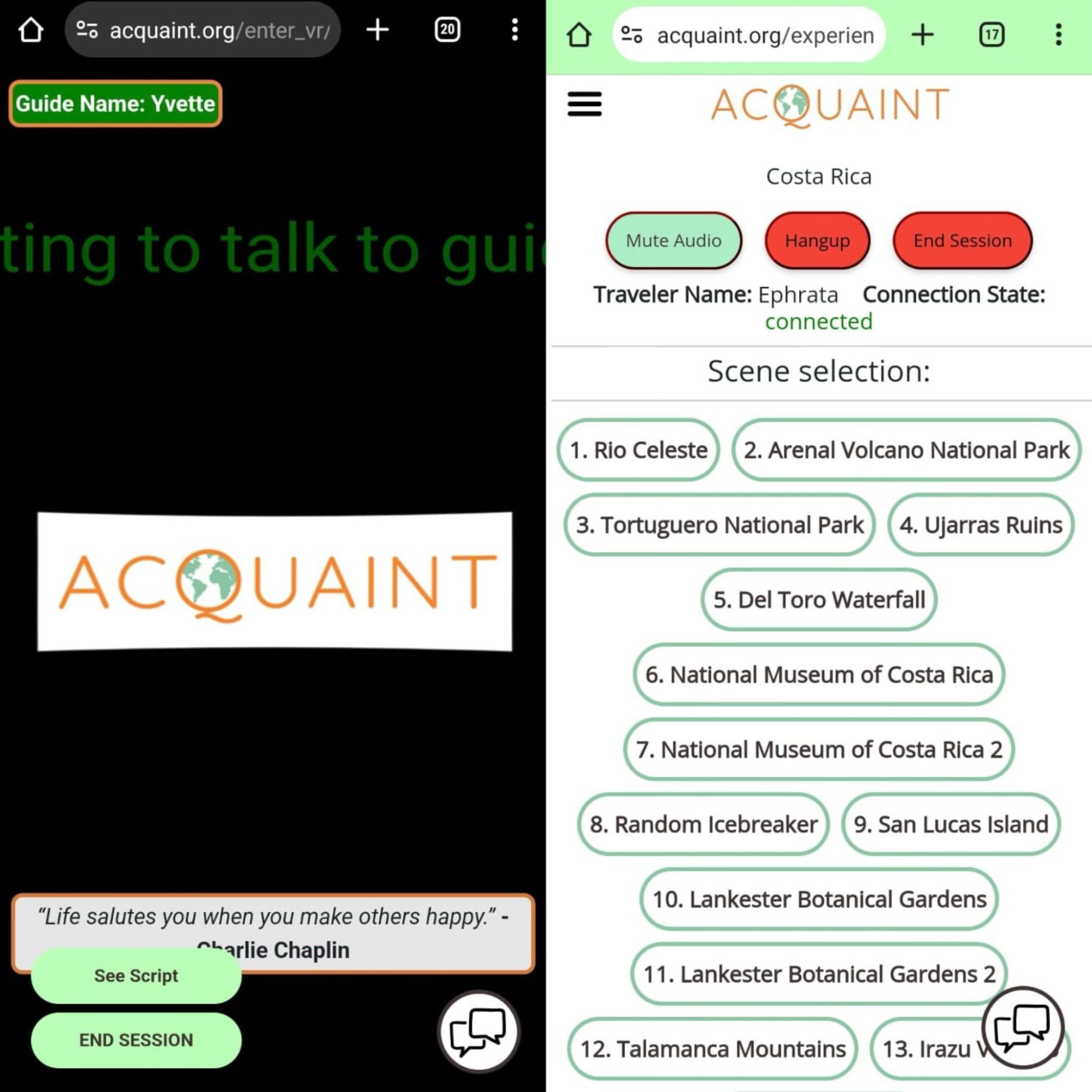
An Acquaint session — an open space to speak and connect.
• • •

Conversations with friends — an open space to talk.
Speak, Share, Connect
To those who are struggling to communicate better, or who want to be part of something larger than themselves, I encourage them to explore Acquaint and join a beautiful global community that prioritizes “in-moment human connection.”
Learning a language is not only about grammar or fluency; it is about having the courage to share your thoughts, your stories, and your perspective with others. When people are given a space where mistakes are welcomed and voices are respected, confidence begins to grow naturally.
Sometimes, all we need is not another lesson, but a place where we feel heard, supported, and understood. In such spaces, language becomes more than just words; it becomes a bridge between people, cultures, and experiences.
Why wait? Jump into a conversation, laugh, learn, and find out how fun speaking English can be when you’re there to connect.
Zainab Hussain joined Acquaint as a volunteer and now leads volunteer coordination and partnerships. An HR professional with a background in English literature and language, Zainab leads efforts in volunteer recruitment, coordination, and building international partnerships. Driven by a passion for connection and learning, she enjoys creating environments where people from diverse backgrounds can collaborate and thrive. Acquaint is a nonprofit building infrastructure for human connection, facilitating one-on-one conversations between volunteers in 110+ countries through its Global Conversations program. Learn more at acquaint.org.