

–an intervention–
We noticed that a recent Chronicle of Philanthropy article, Nonprofits’ Addiction to Jargon Is Eroding Public Trust, was written in institutionalese — so we attempted to translate it so everyone could benefit.*
institutionalese (n.): the language institutions speak in*
The translations below attempt to be faithful to the author’s meaning, without the fluff.
The Translations
“The sector’s language has drifted away from the people it serves and whose trust it depends on.” Nobody knows what you’re talking about.
“It is the product of incentives that reward reassurance to funders, boards, and regulators over clarity to the public.” You write for the people who pay you, not the people you help.
“Specific claims may expose a nonprofit to scrutiny.” Being specific makes it easy to prove you’re wrong.
“Saying ‘We advanced housing stability through coordinated interventions’ satisfies compliance while committing to far less.” If you’re vague enough, you can’t be wrong.
“Institutions survive only if others are willing to defend them. That won’t happen if the public cannot explain, in plain terms, what those institutions actually do.” If people can’t explain what you do, they won’t fight for you when your funding gets cut.
“As the nonprofit and philanthropic sectors professionalized, language became a signal of belonging.” You talk like this because everyone at the conference talks like this and you want to fit in.
“Saying ‘We facilitate cross-sector capacity building’ instead of ‘We help organizations work together’ demonstrated training and fluency.” Big words prove you went to grad school.
“When nonprofits rely on professionalized jargon, they quietly signal that the work is meant for insiders.” Normal people read your website and leave.
“Using the right moral language signals values alignment and lowers risk.” Saying the right thing became more important than doing the right thing.
“It’s safer to say a program ‘advances equity’ than to describe exactly what it does, for whom, and with what result.” Nobody argues with your values, so you never have to show your work.
“Language becomes performative, signaling virtue without requiring accountability.” Sounding good is easier than being good.
“People do not experience ‘housing instability.’ They experience the fear of losing their home.” This is a good sentence. We’re leaving it alone.
“Analysis requires abstraction. Trust requires recognition. The sector needs both, but too often it chooses the first and forgets the second.” You’re so good at studying problems that you forget to talk to people.
“The sector is ensnared in a web where goodwill circulates within institutions but rarely reaches the public.” You’re all patting each other on the back in a bubble.
“Plain language and concrete outcomes are not signs of weak thinking.” Talking like a normal person doesn’t make you stupid.
“Commitments to justice will remain words on paper rather than practices people can recognize in their own lives.” Talking about helping isn’t helping.
• • •
Now In Plain English
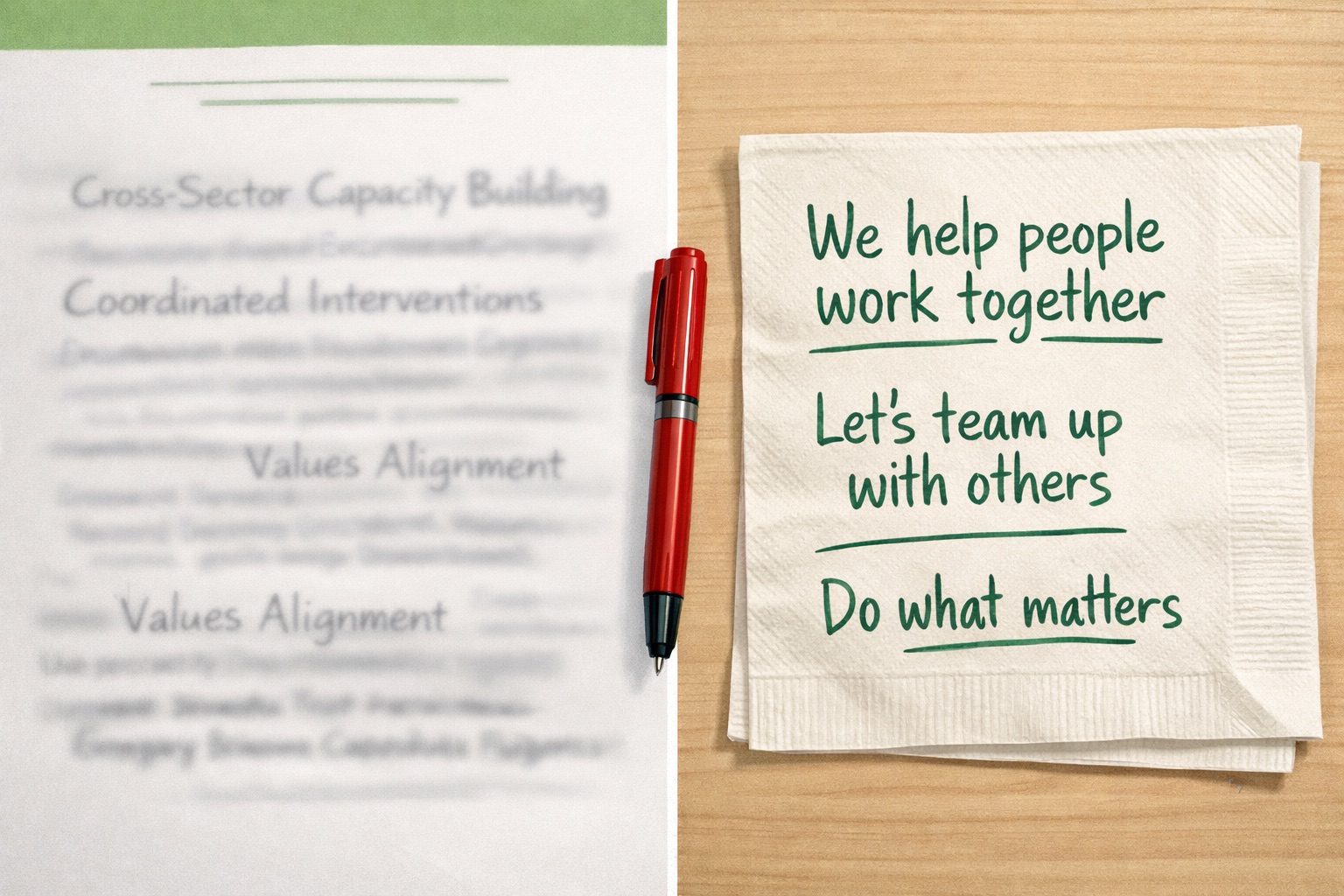
Dear nonprofits:
Nobody knows what you’re talking about.
You write for the people who pay you, not the people you help. When your funding depends on not being wrong, you learn to say things that can’t be proven wrong. Grants reward language that sounds safe to reviewers, not language that makes sense to neighbors. But if people can’t explain what you do, they won’t fight for you when your funding gets cut.
Vague language became expected of nonprofit professionals over time as a sign you know what you’re doing. The right vocabulary signals that you belong. Unfortunately, it doesn’t make sense to anyone else. Funders want safe language, professionals want smart language, and the public just wants to understand what you do. And this never improves, because the language makes people feel dumb for asking questions.
Over time, analyzing the problem replaced listening to the people living with the problem. People do not experience “housing instability.” They experience the fear of losing their home.
The public defends people like them, not theories. If your work sounds like a textbook, nobody cares.
You don’t have to sound smart. You have to be understood. I’ll tell you how next month.
• • •
Buzzword Bingo: The Final Score
No article about using too much jargon is complete unless it uses jargon to make the point. Does this article make the cut? Here’s what we found.
Obviously jargon (nobody says this at dinner): 25 instances — cross-sector capacity building, coordinated interventions, housing stability, systems thinking, values alignment, scoring rubrics, feedback loops, professionalization, civil society, root causes, food systems, performative, defensibility, practitioners, abstraction…
Probably jargon (sector-coded — means something different inside nonprofits): 44 instances — sector (×8), institutions (×8), compliance (×4), philanthropy (×4), accountability, equity, outcomes, goodwill, frameworks, gatekeepers, signaling…
Maybe jargon (real words, but used in sector-specific ways): 50 instances — language (×18), trust (×7), systems (×4), justice (×4), values (×3)…
Conservative estimate: 1 in every 10 words is jargon. Liberal estimate: 1 in 7 (did I get that backwards?).
We wrote about a related problem in the bridging field last week. We’re not immune to “institutionalese” either. But we’re trying.
Alex is Co-founder and CTO of Acquaint. Acquaint is a nonprofit building infrastructure for human connection, facilitating one-on-one conversations between volunteers in 110+ countries through its Global Conversations program. Learn more at acquaint.org.